


The Current Status of Armory Management and Weapon Tracking
It is incumbent for any organization storing and utilizing weapons to have critical data in a database corresponding to their weapons, gear, ammo and personnel. The requirement is to identify, track and manage lethal weapons, weapon attachments, non-lethal weapons, magazines, tactical gear, drones, explosives and/or any items being stored by an armory, warehouse, depot or training facility.
There are well over 1,000,000,000 long guns and handguns in global circulation, with civilian holdings representing approximately 85% of the total, or, 850 million + weapons held by civilians and 150 million + weapons held by governments and other security forces, as summarized in this study: (https://www.smallarmssurvey.org/database/global-firearms-holdings).
The most common applications for armory management and weapon tracking system include:
- Military security armories for security personnel protecting military facilities, and warehouses for military personnel weapons, gear and ammo.
- Law enforcement including Police and Sheriff’s departments for weapons, gear and ammo issued to law enforcement officers.
- Detention centers, jails and prisons for weapons, gear and ammo issued to Corrections Department staff.
- Government entities including Immigration Services, Border Control, Homeland Security, Embassies, and other government entities holding weapons, gear and ammo.
- Private security companies that provide armed security services for governments, commercial entities and high-risk individuals.
- Commercial gun shops and firing ranges.
- Armored vehicle companies that transport currency and valuables.
- Commercial entities that have in-house security personnel, including any prominent company, particularly in volatile countries.
- Government entities to control the firearms that are in possession and licenced-to civilians and security companies.
Current Operational Procedures for Managing Weapons, Gear and Ammo
In the modern world, it would be expected that organizations holding and utilizing weapons, gear and ammo would be utilizing advanced computerized software and tracking technologies for performing their operations.
However, most organizations holding and operating weapons, gear and ammo are utilizing paper-based forms, file folders with documents, registry books and/or .xls spreadsheets to manage this critical information. All of these manual methods are slow, error-prone and inadequate for the accountability and information integrity required as relates to weapons, gear and ammo, and, the personnel that utilize these assets.
Weaknesses of Manual Operational Procedures Commonly Utilized for Armory Management and Weapon Tracking
Weapons, Gear and Ammo Data Reconciliation
A significant risk to the accountability of weapons, gear and ammo is reconciliation of procurement data against the data that is in a back-end procurement system, to ensure that the items procured actually end up at an armory, storeroom, warehouse or depot. Unfortunately, through mismanagement through the use of manual systems, or corruption, it is too common that weapons, gear and ammo that are procured are not received by an armory, storeroom, warehouse, depot or training facility. For effective accountability of weapons, gear and ammo, there has to exact reconciliation of items-ordered against items-received. Manually adjudicating this data is slow and error-prone, resulting in weapons, gear and ammo that cannot be accounted for properly.
Reporting
A fundamental weakness of the current operational procedures utilized by organizations managing armories, storerooms, warehouses, depots and training facilities with manual processes, is that it is most often highly difficult or impossible to produce appropriate reports detailing the ownership, disposition, status, location and history of weapons, gear, ammo and personnel. There should be a computerized database that includes all of the reports required, with any of the reports able to be generated within seconds by a push of a button.
History / Chain-of-Custody
A modern, efficient armory management and weapon tracking system should include the ability to immediately identify the complete history of all weapons, gear and ammo, as to acquisition, movements, maintenance, status changes and final disposition. Producing historical records for weapon, gear and ammo assets is highly difficult or impossible when requiring the referencing of paper-based forms and documents and/or spreadsheets.
This also applies to personnel and their ID card updates, weapon assignments, weapon certifications and ARM / DO NOT ARM status. Further, to be able to view or produce reports related to the complete history of all personnel and all weapons, gear and ammo that they have been Issued and/or Turned-in over time.
Issues and Turn-ins
Tracking the Issues and Turn-ins of weapons, gear and ammo is critical to the operations of an armory, storeroom, warehouse, depot or training facility. Keeping track of the Issues and Turn-ins of weapons, gear and ammo is slow and error-prone when performed utilizing paper documents or .xls spreadsheets, in addition to the chain-of-custody being quite difficult and time consuming, with too high probability of errors in asset/personnel data accuracy and historical reporting.
Inventories
It is typical that an armory or storeroom that is issuing weapons, gear and ammo for shift duty performance by personnel (such as an 8 hour or 12 hour duty shift,) and that receives weapons, gear and ammo from personnel after a duty shift has been completed, is required to inventory the armory or storeroom after the shift turnover (processing of Issues and Turn-ins) has been completed.
Armorers or administrators should be able to instantly produce a report accurately indicating the weapons, gear and ammo currently Issued to personnel, weapons, gear and ammo that are in the armory or storeroom, and, any weapons, gear or ammo that are issued to personnel and overdue for return. This is quite difficult for an organization to perform using clipboards and paper forms, or even if using a laptop, tablet or PDA device.
Personnel Profiles and Credentials for Personnel Authentication and Approval to ARM
Prior to issuing weapons to personnel, it is essential to authenticate personnel as to who they are, their identification # and personnel data, assigned weapons, weapon certifications and their ARM/DO NOT ARM status. With the manner of current operations of armories, storerooms, warehouses, depots and training facilities, authenticating personnel is most often performed visually by CAC card or other identification card, or verbal/visual identification, which do not produce data or historical records.
Manual personnel authentication and authorization to receive weapons leads to gaps and errors in ensuring that the right officers, with the correct status, receive the correct weapons for compliant and authorized carry of weapons. Manual procedures do not utilize readily available software and technology, such as fingerprint scanning to authenticate personnel. If weapons are issued to personnel that are not authorized to receive the weapons issued, compliance is broken and there is safety risk to other personnel and civilians.
Chain-of-Custody
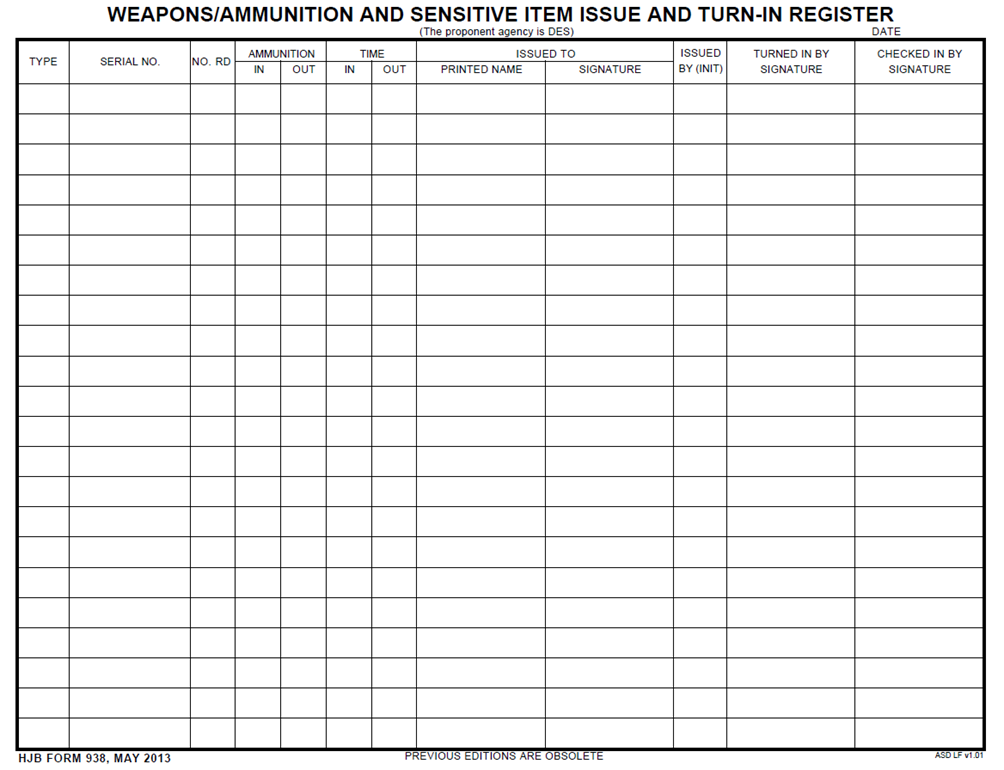
Most armories and storerooms utilize registry books or log forms that indicate what weapons, gear and ammo are Issue-to personnel. These books or forms are used to manually input the items that are transferred and returned, with signatures of the armorer and the officer receiving the items. As such, to produce a history of what weapons, gear and ammo an officer received over time requires accessing forms or reviewing log books that typically takes many hours and is error-prone. Whereas with a software-based armory management and weapon tracking system, with a touch of a button, complete histories of personnel, weapons, gear and ammo can be instantly produced.
Weapons Maintenance
For compliant and safe operations, weapons must be test-fired, cleaned and inspected on-schedule to ensure that weapons are in proper working order. These tasks are performed on a defined time interval and must be performed according to those time intervals for the weapons to be properly authorized for duty. Most armories and storerooms utilize manual record keeping or spreadsheets to keep track of the dates that weapons are due for test firing, cleaning and inspection, and the results of these tasks are manually entered to a form or spreadsheet. As such, it is time consuming and difficult to verify that weapons are ready for duty at any point in time, or to prove that the weapons have been maintained properly to meet compliance and operational guidelines over time. Inadequate weapons maintenance violates operational rules and puts personnel, other staff and civilians at risk due to weapon malfunction.
Personnel Maintenance
Information about and credentials of personnel change over time. Demographic data, such as contact information, rank, superior officer and such data all changes over time. Identification credentials, such as represented by ID cards, must be updated and renewed according to a defined schedule. Officers must be assigned weapons and must test fire those weapons to receive and renew weapon carry certifications over time.
If a personnel member has a disciplinary or health status that prevents or renews their authorization to carry weapons, the status of personnel authorizations must be updated through weapon tags, forms or spreadsheets. These manual methods are difficult to maintain and are prone to error, leading to weapons being issued to personnel that are not authorized to receive the weapons, causing compliance, safety and legal risks.
Security
Manual armory management and weapon tracking systems have significant weaknesses related to the security and compliant use of weapons. Without software, it is difficult to ensure that standard operational procedures are being properly followed and maintained. Without technology, such as ID card readers or fingerprint scanners to authenticate personnel, or electronic signature pads to ensure proper acceptance of custody of weapons, gear and ammo by personnel, there is a gap in accountability.
Technology can also be utilized at armory, storeroom, warehouse, depot and training facility exit points to sound alarms and trigger cameras if a weapon approaches an exit in an unauthorized manner. Manual systems cause any organization utilizing weapons, gear and ammo to have high risk of security breach at all times.
Summary
There is need for greater accountability and security for the management of armories. What did the procurement department order and what was actually received at warehouse(s) and/or armory(s)? Can we account for all weapons, gear and ammo at every moment in time, instantaneously…and the data is correct? Are we automating Issue, Assignment, Return, Check-in, Check-out processes? Can we perform rapid and accurate inventories of armories and warehouses? Can we prevent the unauthorized removal of weapons at exit points? These and many other considerations are addressed through proven vendor-provided armory and warehouse management solutions for weapons, gear and ammo.
The Components of an Armory Management and Weapon Tracking System
A weapon tracking system provides registration, tracking, accountability and security of weapons, gear and ammo for armories, storerooms, warehouses, depots and training facilities. The primary components of a weapon tracking system include:
- Software
- Configuration of software to an organization’s requirements
- Hardware devices for authentication personnel, tracking items and for chain-of-custody
- Security devices to prevent the unauthorized removal of weapons
- Barcode labels, RFID tags and GPS tags for identifying and tracking all items in an armory
- Installation and training services for system deployment
- Ongoing personnel support and hardware maintenance
Armory Management Weapon Tracking Issue and Turn-in Processes
Weapon tracking armory management software best practices is accomplished by utilizing COTS commercial-off-the-shelf software (https://csrc.nist.gov/glossary/term/commercial_off_the_shelf) that is rapidly configurable to an organization’s specific data, workflow, tracking, security and reporting requirements. COTS software is the preferred alternative versus the development of a new software application.
COTS armory management solutions provide the full features of the vendor’s software based on the vendor’s internal software design efforts, and based on the features and functions requested-by and provided-for all prior customers. The software continually advances over time through deployments for multiple clients over years or decades, providing a mature, proven solution with the highest probability of the success of a system deployment and the success of the system over time.
COTS solutions eliminate the risks and costs of a custom developed solution, providing a known and quantifiable solution that is ready for deployment within weeks, at a specific, defined cost. Custom developed systems are performed based on expected outcomes and expected costs, however, these are estimates that often change over time…expected outcomes are often reduced and expected costs increased. Further, vendors maintain the critical staff necessary to maintain and evolve the system, whereas with custom-developed systems, key staff can resign or be terminated, and the knowledge behind the custom-made software is lesser than had the key staff remained stable over time. As staff rotate, maintenance and advancement of the software becomes more and more difficult over time. Additionally, it is highly unlikely that an organization would have the staff and expertise in all areas of an armory management system, including software, hardware, labels and tags that are required to have a best-practices and optimally performing system. COTS software best ensures continuity and top performance, at defined and mutually agreed costs.
Following are the primary capabilities of armory management weapon tracking software:
Unlimited software templates
A template within an armory management weapon tracking solution is a collection of data fields and data field drop-down lists that are configured for an organization’s specific requirements. Software templates support both serialized (uniquely identified) and non-serialized (an item-type where all items share a common identification, such as a common barcode). The armory management weapon tracking software can be configured with a single template including fields to define all of an organization’s object types, or, separate templates can be configured so that data is more precise based on the object-type. Example templates can include any or all of the below:
Tactical personnel
System administrators and users
Item Categories including serialized items that have unique ID / serial #, and non-serialized item-type that do not have a unique ID per item, rather all of the item-types share a common ID (such as boxes of ammo)
- Serialized Lethal weapons, weapon attachments, magazines and ammo
- Other serialized items, including non-lethal weapons, various gear items, and other items such as drones
- Non-serialized items such as holsters, boxes of ammo etc.
Item-Types within templates
- Lethal Weapons (handguns, long guns, machine guns, launchers, etc.)
- Weapon attachments
- Magazines and ammo
- Non-Lethal Weapons
- Tactical Gear
- Drones
- Explosives
- Pelican cases
- Boxes, bags, bins etc.
- Parts
Organizational and Personal Dashboards
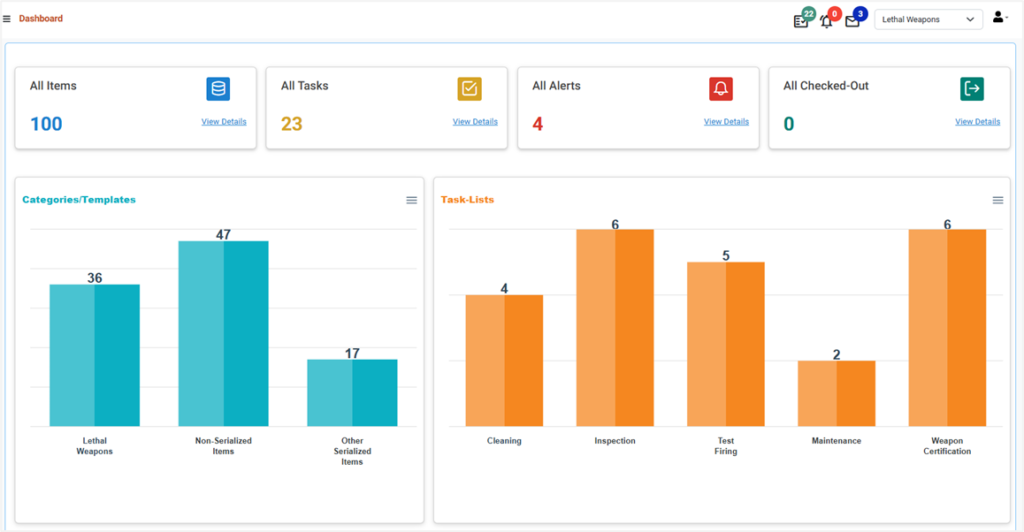
- Organizational dashboards utilize graphs, charts and data to provide an armory management software User a snapshot view of the armory’s most important management information, such as items, statuses, tasks, alerts and checked-out items. Upcoming tasks display on a dashboard calendar that show when tasks are due and any alerts relative to overdue tasks.
- Personal dashboards display rows of data for all tasks and messages received by weapon tracking system Users, keeping staff continuously updated on their work requirements and their participation in task workflows. Users can open and respond to messages and can open and execute tasks, update task status, route tasks and update task workflows. If any task is overdue for performance, a ‘caution’ icon in red displays as a part of the task row in the task table/list.
Issues, Returns and Assignments (Check-out and Check-in)
The management of weapons, gear and ammo being Issued and Turned-in and is a component of the command center armory management software, managing critical data elements to enable rapid and accurate tracking of items Issued or Returned according to compliance requirements and best-practices. Armory management weapon tracking software automatically performs database lookups to quickly guide the User through check-out processes according to standard operating procedures. Core tracking capabilities include:
Personnel Authentication
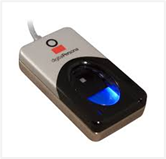
Personnel that are to receive weapons, gear and ammo for short-term duty cycle or long-term assignment must be authenticated prior to transferring items to the person. Personnel authentication can be performed by:
- Sight and familiarity
- Database lookup to review photo and personnel data
- ID card scan
- ID card visual review
- Fingerprint scan
Once an officer, solider or any security person is authenticated, the armory management weapon tracking system will automatically verify the officer’s identification card status, assigned weapons, weapon certifications and ARM-DO NOT ARM status. Upon personnel authentication, the armorer can proceed with issuing items to the person.
Issue, Assign, Checkout
Once a personnel member is authenticated, when they are being enrolled as a ‘long term’ solider or officer, or when temporarily being issued weapons, gear and/or ammo for temporary duty, the person can receive weapons and items in compliance and according to standard operating procedures:
Database lookup of the person’s ARM / Do Not ARM status. If person has been designated ‘Do Not ARM’, then legal, compliance and standard-operating-procedures dictate that no weapons are to be Issued to this person. If weapons are Issued to this person and there is an incident where a weapon or weapons are drawn or fired, there can be significant legal organizational and/or civic public relations consequences. Personnel can be marked ‘Do Not ARM’ for disciplinary, legal, psychological or for any reason deemed appropriate by command / management.
If the person is marked ‘ARM’, then the armory management weapon tracking system automatically looks-up the weapon-types and the specific serial #’s that are assigned to the person. This is typically based on the common operational practice that the weapons that personnel utilize when being trained, test firing and being certified to carry weapons, are the specific weapons (based on serial #) to be Issued to the person for duty. The weapons assigned to the person automatically display on a modern armory management tracking system computer screen and/or tablet PC. Additionally, if there is weapon dependent gear, like a sight, those objects will also display on the tracking screen. Further, the # of magazines that are prescribed for check-out for each weapon-type also display on the tracking screen.
If the person is being deployed to a specific duty-station or post, then the Armorer can select the Post to which the person is being dispatched to perform duty, and all weapons, gear and magazines required for that post-assignment will also automatically display on the screen, including both serialized items as a one-each unit, and, non-serialized items which are designated by selecting a quantity.
The armorer will pull from within the armory each of the items that displayed on the armory management weapon tracking system Check-out screen that were not deleted from the transaction. As well, the armorer can pull any items that the Armorer deems appropriate for the duty assignment and real-time circumstances, though the items may not have automatically displayed after the person’s authentication and post/duty designation. When an item is pulled and is moved by the Armorer to a check-out computer station, or by using a tablet PC, the Armorer can validate that the custody of each item that is being transferred follows standard operating procedures and best practices, including these typical processes:

- Lookup the item in the database and verify the item ID number based on the data in the database.
- View an item’s factory displayed serial number and input that number with electronic or physical keyboard.
- View an ID # that has been etched onto or written in magic marker on the item and input that number with electronic or physical keyboard.
- View an ID label on the item that shows a unique ID number and input that number with electronic or physical keyboard.
- Scan a barcode on the item with a USB scanner (used hands-free or in-hand), mobile scanner or tablet.
- Scan a RFID tag on the item with a USB scanner (used hands-free or in-hand) or mobile RFID / barcode scanner.
- Issue-Return windows and / or doorways can be equipped with network connected RFID antennas that automatically detect items being passed by an Armorer to a recipient without the Armorer being required to physically scan the RFID object being transferred to personnel.
- Laptop or computer can permanently reside upon, or be temporarily placed, on a rolling cart, along with tracking scanner, electronic signature pad, fingerprint scanner, printer, and any other hardware, for moving from within an armory storage location to Issue-Return windows or doorways for convenient transactions at each physical location.
- For non-serialized items, without a Unique ID number, the Armorer can scan an item-type barcode with mobile scanner or tablet that is placed on storage locations in proximity to the items, or utilize an binder that is used at tracking and stations and that display each item-type with photo, data and barcode, enabling Armorer to scan an item-type barcode and then decrement the items being transferred to indicate that they are being Issued to the person’s custody, or, otherwise being dispensed.
The armorer can rapidly delete any weapons, weapon dependent gear, gear, magazines or non-serialized items that are not going to be Issued.
All of the items that are being Issued and checked-out by the Armorer can be displayed for the recipient’s visual inspection prior to accepting custody of the items that the Armory indicates are being transferred. The primary methods that armory management weapon tracking systems utilize to validate transfer-of-custody include:
- The armorer can unilaterally transfer custody without the person receiving weapons, gear and ammo having any oversight or visibility.
- The items being transferred to the recipient can display as data on a large, high resolution electronic signature pad screen, including item type, description and serial #.
- The items being transferred to the recipient can display on an external monitor, including photo, item type, description and serial number.
- The armorer can hand a tablet PC showing the items being transferred to the person’s custody on the tablet.
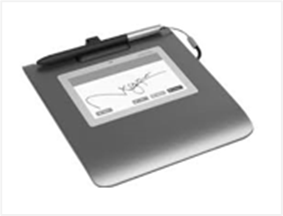
The recipient either signs the electronic signature pad, enters their personal identification # (PIN #) on the remote monitor screen, or enters their personnel PIN # to validate their receipt and acceptance of the items that they were issued by the armory.
- During the check-out process, an organization using a modern armory management weapons tracking system can produce any forms that are required according to standard operating procedures, utilizing the data from the computerized check-out process to populate the form(s). Modern armory management weapon tracking systems enable forms to be generated matching formal form design standards, and the form(s) save to the database, can be emailed.
The Armorer then can finalize the Issue transaction and all of the locations of all of the items transferred to the custody of the recipient are updated within the armory management weapon tracking system database. An audit trail record of the transaction is also saved to the database (which cannot be deleted), that includes data about the Issue transaction and including pointing to electronic signature or fingerprint as a proof-of-transfer-of-custody of the weapons, gear and ammo Issued to the recipient. Check-out audit trail records include Armorer Issuing weapons, gear and ammo, person receiving the items, date and time and the items transferred.
Returns
Utilizing a computer, laptop or Tablet PC, when personnel present to return the items that were Issued to their custody, the following processes occur:
- All of the items that were Issued to the person at the onset of their duty cycle, display as photos and data on the Return / Checkin software screen.
- Items are checked-in by RFID antennas, USB scanners or by entering serial numbers by keyboard, and all of the items are quickly returned to the armory, which should require approximately 30 seconds or less.
- Each time that weapons, gear and ammo are returned to an armory, an audit trail record is created including the person returning items, the Armorer receiving the items, the items received, date and time.
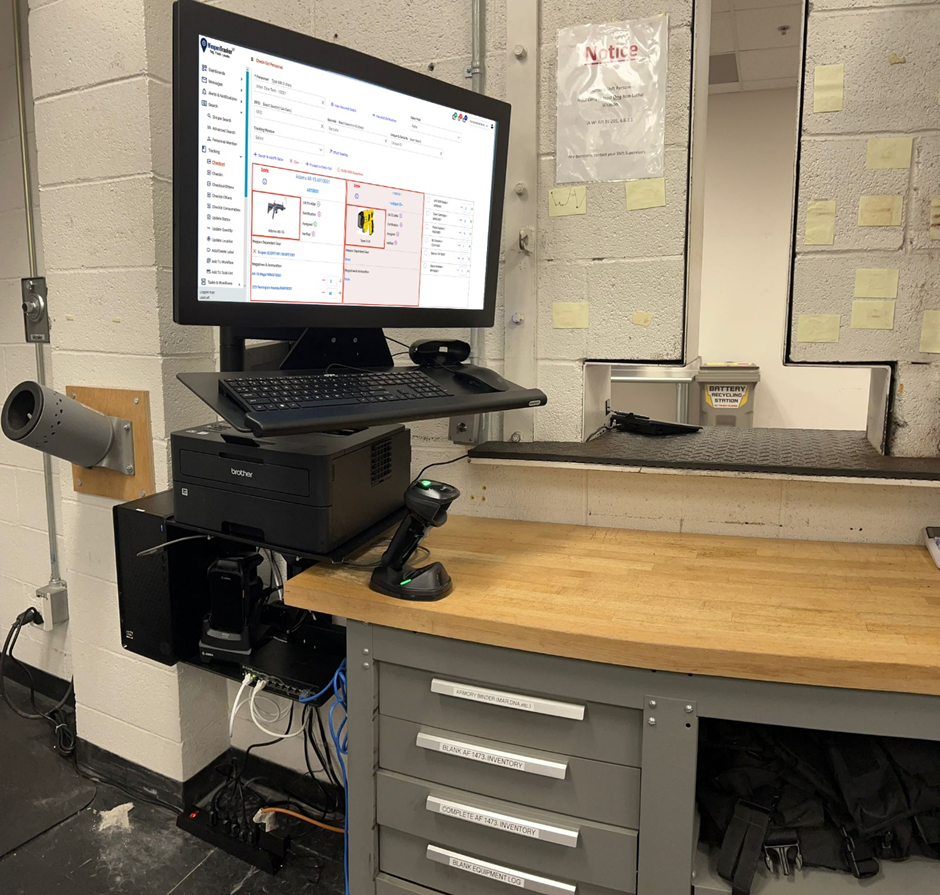
Identifying and Placing Barcode and RFID Labels on Weapons, Gear & Ammo
A leading armory management weapon tracking system will support a wide range of tracking technologies, and can blend tracking technologies based on the needs of the organization implementing a system and the mechanisms by which weapons can be labelled or tagged. The primary tracking methodologies and technologies for all items in an armory, including weapons, gear and ammo, are discussed below:
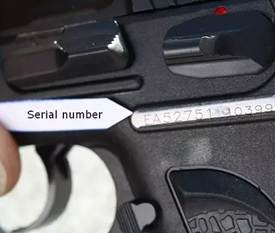
Unique serial #’s visible on weapons and gear
Most armories today are tracking weapons, gear and ammo using unique (serialized), or, common (non-serialized) identification numbers, depending on the item-type. In many cases, weapon and gear manufacturers place an identification number on the items that they deliver to an organization, or, have an identification number indicated on the weapon or item during manufacturing. Some armories also use etching tools, internally produced labels or magic markers to identify each item with a unique identification number.
Modern armory management weapon tracking systems enable system Users to query the database to Search for an item in the armory management tracking system software, to identify the unique identification number to locate or perform tasks relative to the items.
These identification numbers can be input by physical or electronic keyboard via a computer, or, by utilizing mobiles scanners, tablets and/or phones. Below is an example:
Barcode technology
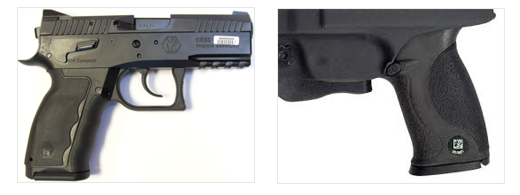
When implementing an armory management weapon tracking system, many organizations place barcodes on each weapon, magazine and/or gear item. Barcodes are typically provided to customers with sequential #’s, starting with number 000001 and ascending depending on how many items are to be barcoded. The sequential barcode number is input to the armory management weapon tracking system software database record for each item that is barcoded, linking the barcode # to the unique ID serial #, so that scanning a barcode is the equivalent to keyboard entry of the serial number. There are two (2) primary types of barcodes: 1) 1D barcode, which most people are familiar with, such as a product UPC barcode number and 2) 2D barcode which is smaller in size. These barcodes can be made of a poly or metal material, and are designed according to MIL-SPECS Universal Identification System standards set by the U.S. DOD. As example:
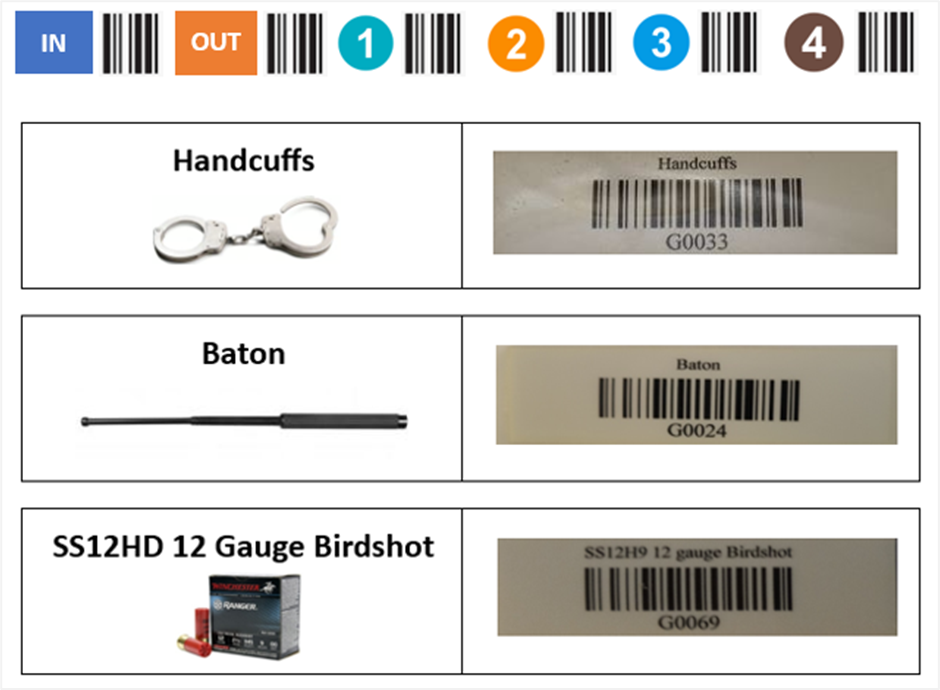
Non-serialized items in an armory require different processes for identifying, tracking and inventorying. There are some item-types, such as boxes of ammunition, that all share a common barcode number, and some items have no barcode or visual identifier…they are just an item-type within the database software…such as a holster. For the item-types that do not have unique ID #’s, all items of a specific item-type utilize the same item-type identification number, which can be represented by a barcode. There are other items like OC Spray, handcuffs, flashlights and similar items that may each have a unique identification number, but the items can be managed based on a common, non-unique identification number and barcode. When utilizing item-type barcodes, a barcode is scanned for the item-type and then the item is incremented (when being added to inventory upon procurement or when being turned-in by officers after duty) or decremented (when items are issued to personnel or when items are retired). When items are being Issued, the items are decremented (removed from the armory) and when items are first received by the armory and being added to the armory inventory, the items are incremented (added to or returned to location = armory).
There are two primary methods for automation of the tracking of non-serialized items, based on a common identification number and/or barcode 1) barcode labels that identify non-serialized item-types can be placed at storage locations in proximity to the item-type in storage, and the item-type barcodes can be scanned with a mobile scanner or tablet and then incremented or decremented on the items removed or returned 2) Item-type barcodes can also be placed in a Asset Registry Binder that includes the barcode, photo and item-type data for each item-type. The common identification number barcode number can be scanned with USB barcode scanner to identify the item-type and the software utilized to increment (turned-in) or decrement (issued) with the quantity being issued or turned-in.
Barcodes are available that meet U.S. Department of Defence ‘Mil-Spec’ requirements and are available in metal and poly materials. Barcode technology supports scanning one barcode label at a time from close proximity, with USB, Bluetooth, mobile scanner or tablet.
UHF RFID Technology
UHF (Ultra-High Frequency) RFID enables many tags to be detected concurrently and from distances up to approximately 40’, and supports passive tracking of weapon, gear and magazines at Issue-Return windows and at exit doorways.
RFID tags are available in many sizes and materials, including ultra-thin RFID labels, and can be placed within long arm and sidearm grips or on the exterior of weapons. RFID tags can also be placed on the exterior of gear and magazines, as well as on cartons and cases.

Weapon, Gear and Ammo Tracking Stations
Modern, computerized armory management systems enable identification of all item-types by barcode and/or RFID, and scanning of all items at time of Issues and Turn-ins. Scanning weapons, gear and ammo when being Issued and Turned-in speeds processes and increases accuracy, by replacing paper-based processes and forms with software and hardware devices.
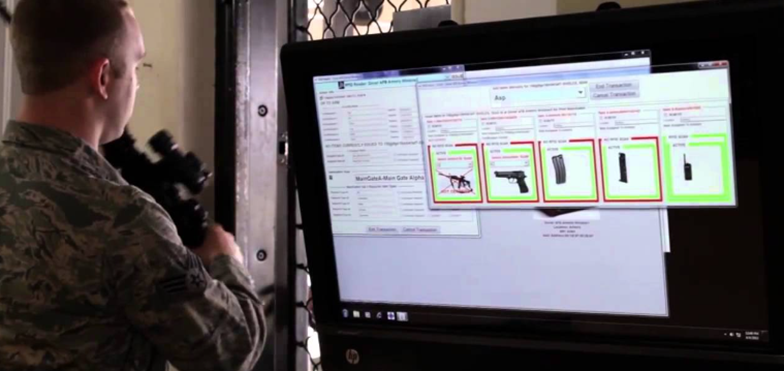
Armory management systems are configured according to each organization’s specific requirements. A tracking station includes the software, that is fully configurable, including support for common global languages. Also included are hardware devices that streamline Issue and Turn-in transactions, with the most common options including:
- Large touch screen monitor connected to computer, or, as a part of a laptop. Enables the use of touch and/or mouse-keyboard to perform Issue and Turn-in functions.
- USB scanner connected to the computer or laptop, that supports both barcode and RFID scans. The USB scanner can be used hands-free or in-hand. The scanner utilizes sound (beeps) and LED lights to confirm that barcode or RFID scans were detected correctly. The USB scanner is the core component of a tracking station, and, is required.
- Authenticating personnel can be accomplished using the software, but is more commonly accomplished by scanning an ID / CAC card. The USB scanner that scans barcodes and RFID on weapons, gear and ammo, can also be utilized to scan barcodes on ID cards. Personnel receiving items from an armory can also be authenticated by a PIN # provided by the person, and, validated by the data/photo in the software. Biometrics can also be utilized to authenticate personnel, with fingerprint scanner being the most common biometric method and device; facial and Iris recognition is also available.
- Validating transfer-of-custody and being able to prove acceptance of custody by personnel receiving items from the armory, is provided by modern, computerized armory management systems through the us of either 1) electronic signature pad that displays all of the items being issued to personnel, including serial #, item-type #, item description and quantity, which receiving personnel can view, confirm and sign their name 2) an external monitor outside of an armory (the opposite side of the window or door versus the armorer being inside the armory and the personnel being outside of the armory) if personnel are receiving weapons, gear and ammo through a window or doorway. The external monitor includes the same data as the electronic signature pad, and also includes a photo of the item. Personnel checkmark the items that they received and enter their personnel ID # to accept custody.
Whether signature pad or external monitor, each Issue and Turn-in transaction produces an audit trail/historical/chain-of-custoy record in the software, including indication of acceptance of custody by receiving personnel by indication of PIN # or signature.
Tracking stations are deployed based on the processes being used by an organization and the physical design of the armory, and similarly for warehouses, depots or training facilities. The most common configurations of tracking stations include the hardware devices and processes preferred by an organization, and are configured as follows:
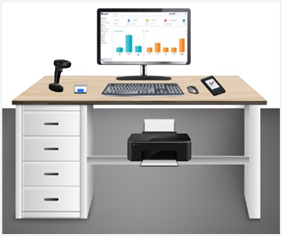
Desktop Tracking Stations – Figure 14
Armories may have tracking stations that are on a desk, counter-top or other work surface. Such tracking stations are straightforward to implement with the type of computer and the hardware devices being deployed for an organization…on the work surface.
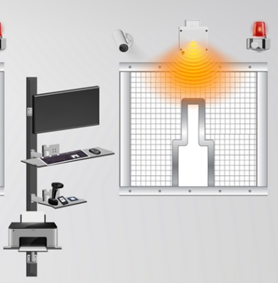
Window Tracking with Wall-Mount Station(s) – Figure 15
Military armories often have Issue / Turn-in windows. Depending on the size of the armory, there may be multiple windows. All of the devices, including the computer/monitor, can be configured for mount-on-wall at Issue/Turn-in windows.
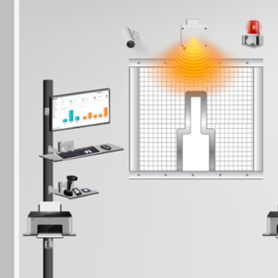
Window Tracking with Rolling-Cart Station(s) – Figure 16
Some armories are not constructed in a manner to have a desktop or wall-mount tracking station. Complete tracking stations can be place on a rolling-cart that can be moved out of the way when not in use, and rolled to a window or doorway for performance of Issue and Turn-in transactions.
Tracking and Security at Armory Exit Points

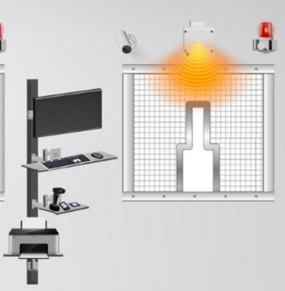
Tracking at exit doorways can be achieved through the use of a wall-mount or rolling-cart tracking station, and potentially, through the use of a desktop tracking station. The required and normal functions performed for issues and turn-ins can be fully executed. Exit points / doorways can also be configured to help prevent the unauthorized removal of lethal weapons, or any RFID-tagged items. Tracking and security stations at an exit/doorway typically include four (4) RFID antennas that detect any item approaching the exit, with triggers an automatic software look-up to determine if the weapon(s) or item(s) are properly authorized for issuance. If a weapon or RFID-tagged item is not authorized for removal, alarm will sound, rotating lights will turn-on and a voice command will announce, such as ‘weapon unauthorized for removal, return to tracking stations’. Motion triggered cameras can be included, which connect alert incidents with the video showing the person(s) that may have exited the armory with weapons or other items in an unauthorized manner.
Armory, Storeroom, Warehouse, Depot, Training Facility Inventories & Audits
After a shift turn-over, a mobile RFID-barcode scanner with PDA/Smartphone, and/or Tablet PC device, can be utilized to rapidly scan RFID tagged items and barcoded items, as well as keyboard entry or selection of non-tagged item serial #’s . Non-serialized items are counted. The armory inventory displays every weapon, weapon attachment, gear, magazine, ammo box, carton, case, part (including quantities where appropriate), so that there is an instantaneous Armory Inventory Report generated after each Issue-Return cycle, demonstrating 100% accountability of all items (indicating all items and the locations of all items).
Modern armory management weapon tracking systems also enable the use of mobile scanners with smart device or Tablet to Audit an Armory. The difference between an Inventory and an Audit, is that an inventory detects ‘what’s in the armory’. Whereas an Audit initiates by displaying all items expected to be in the armory, based on what the armory management weapon tracking software indicates is in the armory, and after scanning all items in the armory, rows of data display including intelligent determination of the status of all items:
- Expected and found.
- Expected and not found.
- Unexpected and found.
As such, an Armorer can adjudicate the operation of the armory and the identification of its items real-time with the mobile scanning system.
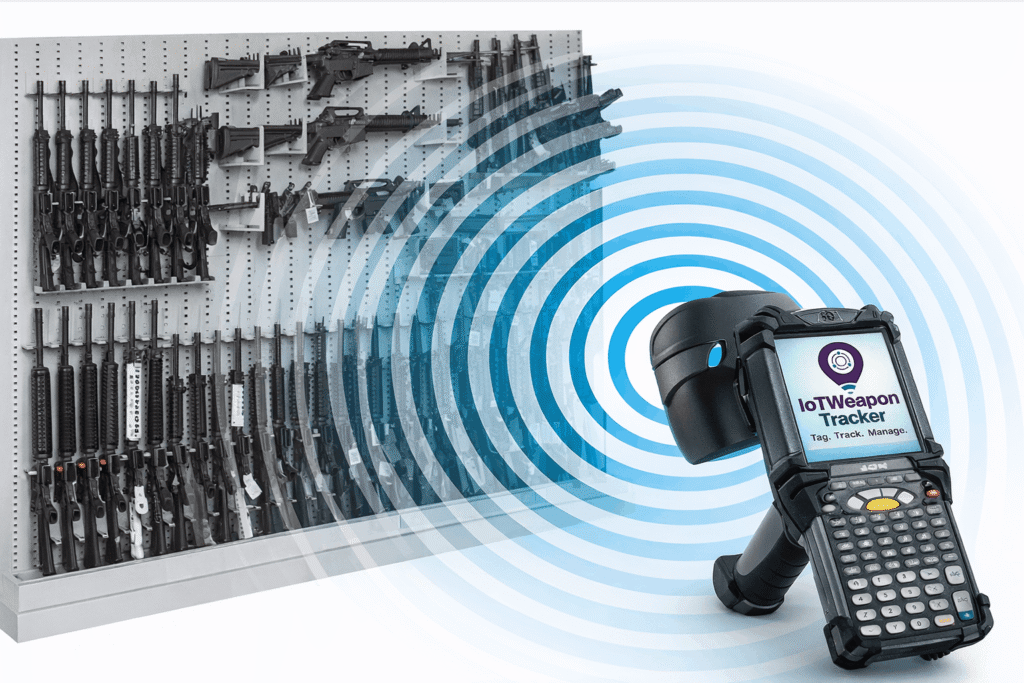
If there are any expected items that were not detected during the Audit, the ‘missing’ item ID numbers can be entered to the mobile scanner armory management weapon tracking system mobile computing system. The scanner transmits radio waves approximately 25’ to rapidly identify all RFID-tagged items. The scanner supports scanning the barcodes on any items that are barcoded, and entering serial numbers by keyboard if required. The mobile scanner utilizes frequency of audible beeps, a cold-warm-hot color scale and a 0 to 100 numeric index to enable Armorers to rapidly locate needed items.
Weapons Maintenance
Modern, computerized armory management weapon tracking systems include the processes for maintaining and executing weapons maintenance functions, including test firings, inspections and cleanings. It is essential for an organization to maintain weapons in proper working order, which requires periodic test firings, inspections and cleanings. Otherwise, personnel have weapons that may not perform properly, producing safety risk to themselves, other personnel and civilians. If weapons are not maintained properly and on-schedule, internal compliance lapses and/or legal challenges arise as to why weapons were not maintained according to requirements/policy. If a shot is fired in the line of duty, it is standard practice review the weapon’s maintenance history to ensure that the weapon was compliant as to its serviceability.
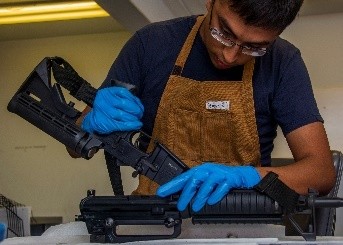
- Test Firing
- Inspections
- Cleanings
- Maintenance
Armory Management System Hardware
There are a wide range of hardware tracking devices to track weapons, gear and ammo, as well as for accountability, security and inventory functions.
Barcode Hardware
Utilization of 1D and 2D barcodes (QR codes) are an efficient method for labelling weapons, gear and ammo, enabling rapid and accurate scanning rather than the manual use of keyboard to enter item and item-type identifiers when performing issues, turn-ins and inventories.

USB Barcode Scanners
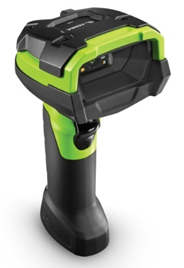
USB bar code scanners enable rapid, accurate scanning of serialized weapon, gear, ammo, cart and case barcode labels for Issues, Returns, Transfers and Assignments. USB barcode scanners have pistol grip design so that the scanner can be utilized in-hand, and are available with stands for hands-free barcode scanning.
Bluetooth Barcode Scanners
Bluetooth barcode scanners function the same as a USB barcode scanner, with the importance difference being that Bluetooth barcode scanners can be connected to a USB port and function as a USB scanner.

Mobile Barcode Scanners
Mobile barcode scanners enable scanning of barcodes on serialized items, and barcodes representing non-serialized item-types (including incrementing and decrementing based on quantities), for performance of inventories and audits.

Barcode Tablet PC
Tablet PC’s can be utilized in an armory for performing issues and turn-in transactions, and for executing inventories by scanning the barcodes on serialized items or item-type barcodes for non-serialized items (with incrementing/decrementing. The barcode tablet PC can also pair to a RFID mobile scanner to enable scanning RFID-tagged items.
RFID (Radio Frequency) Hardware
RFID technology differs from barcode technology in that whereas barcode scanning is one at a time from within approximately 12” (30 cm), RFID scanning is many at a time (hundreds or thousands) all at once from distances up to approximately 20’ (6 meters). RFID technology also enables passive identification of RFID-tagged items when being passed through a window or doorway, as well as the ability to detect weapons approaching an exit to help prevent removal of weapons that are unauthorized for removal from an armory, depot, warehouse or training facility.
USB RFID-Barcode Scanners
USB RFID-barcode scanners include two (2) triggers, one of which prompts barcode scans, and the other trigger which prompts RFID scans. As such, serialized RFID items, serialized barcoded items and non-serialized barcoded items can all be scanned with a single scanner during Issue-Return transactions.
Passive, Automatic Tracking at Windows and Doorways
RFID technology supports the use of network-connected readers to which one (1) or more RFID antennas can be connected that communicate directly with the armory management weapon tracking software.
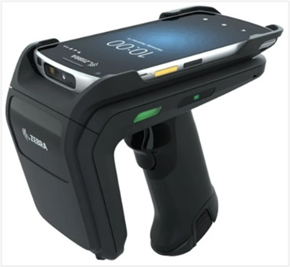
Mobile RFID-Barcode Scanner
Quickly perform inventories and audits, and rapidly locate needed / missing weapons or other RFID-tagged items. Scan 100’s or 1000’s of weapons and other RFID-tagged items in seconds, from up to 20’.
RFID – Alarm – Camera Security Doorways (exit points)
A networked RFID reader with up to four (4) RFID antennas can be placed at doorways / exit points to help prevent the unauthorized removal of weapons or other RFID tagged items from armories. RFID antennas detect weapons approaching exits, and if not authorized properly for removal, alarm sounds, lights flash and voice command.
Computers and Networking
Armory management systems can be deployed via cloud platforms, such as AWS or Azure. Cloud platforms provide quite significant security and redundancy that is often difficult for an on-premise solution to equal. However, most organizations that have weapons, gear an ammo prefer an on-premises, closed, secure deployment not connected to any network or the Internet.
Common IT infrastructure includes:
- Server(s)
- Uninterrupted power supply
- Backup server or external hard drive for disaster recovery
- Routers
- Network switches
- PoE switches
- Workstations
- All-in-one computers
- Laptops
- External monitors
- Tablets
- Networking of computing devices to server
- Printers
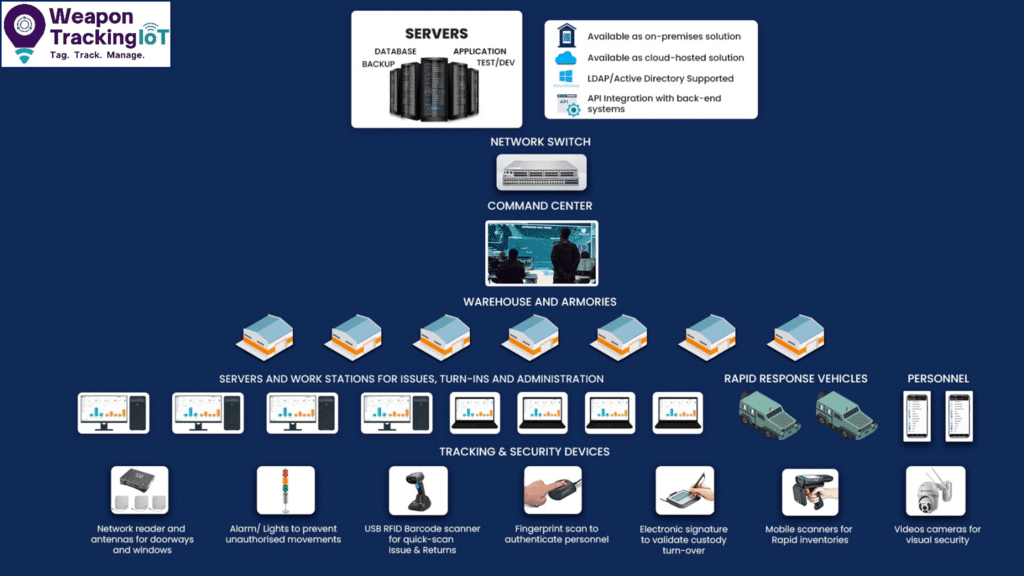
GPS-GSM Weapon Tracking
An emerging paradigm-shift in the weapon tracking business is the advent of weapon tags that include real-time GPS and GSM weapon tracking capabilities anywhere in the world where there is cellular and/or satellite coverage. GPS-GSM weapon tags also have intelligence to produce alerts if operating conditions are outside of norms.

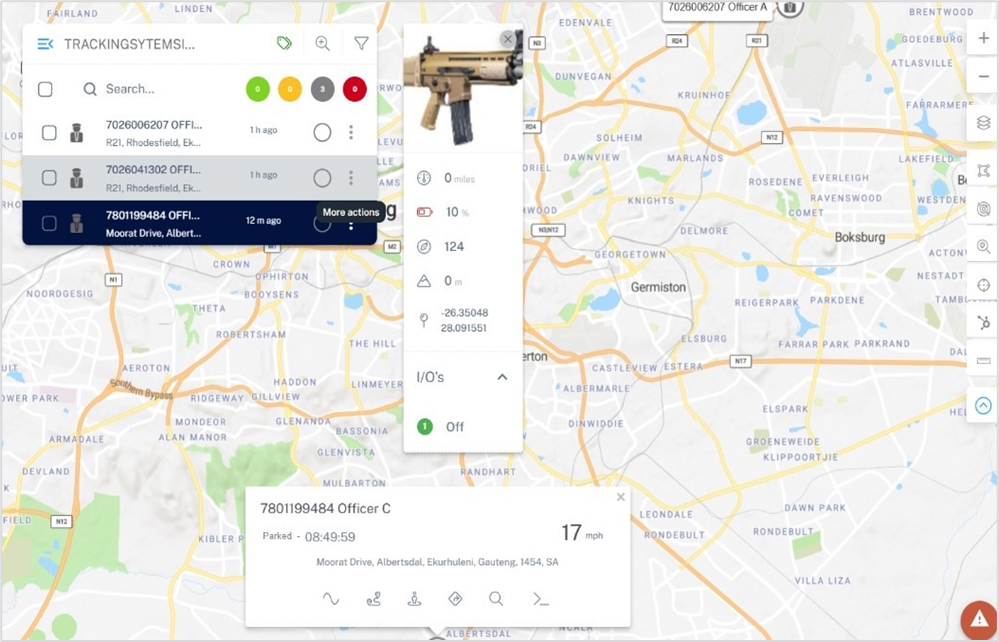
In addition to providing real-time GPS and GSM weapon tracking data and view, the GPS-GSM weapon tags also include intelligent, automatic alerts as to weapon and officer status:

Figure 34: GPS-GSM Geofencing Alerts
The GPS-GSM software platform includes the ability to set geo-fence perimeters around rooms, buildings and land areas. Alert is automatically generated if a weapon breaches the perimeter.

Figure 35: Weapon Unholstered Alerts
Weapon holsters include sensor that identifies when a handgun is removed from a holster. Alert is automatically generated and transmits to the command center software.

Figure 36: Shot(s) Fired Alerts
GPS-GSM weapon tags include a sensor that identifies if shot(s) fired, and counts the number of shots fired. If handgun or long gun is fired, alert automatically udpates the command center software.

Figure 37: Weapon Separated-from-Officer-of-Custody Alerts
GPS-GSM weapon tags include a sensor pairs to an officer personnel ID. If a weapon is left-behind, stolen or otherwise separated from the officer-of-custody, alert transmits to the command center software.
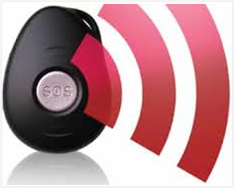
Figure 38: Panic-Button / SOS Alerts
GPS-GSM weapon tags include a pain button that personnel can press to send alert to the command center software, indicating that they are at-risk and/or in an environment of risk that requires response.
Weapon Storage Racks and Cabinets
The number of different item-types, and the quantities of item-types, grows over time. It is quite common that armories, storerooms, warehouses and depots face space constraints over time. Weapon racks and cabinets also enable quick removal and return of weapons, gear and ammo. Additionally, weapon cabinets and racks can be placed on rolling carriages that wheels that roll along metal rails to enable elimination of unnecessary aisles, which typically doubles the capacity for storing items in an armory, warehouse or depot.
- Configurable weapon racks are easily designed to maximize the efficiency of weapons storage in modern, flexible weapon storage racks.
- Store more weapons, gear, ammo, cases and cartons in less floor space.
- Interchangeable components are available to optimize storage of different weapon, gear and ammo-types within a fully integrated storage system.
- Weapon racks can be placed on carriages with wheels and integrated with mechanical and electrical rotators for high density storage systems that eliminate unneeded aisles to fully maximize available floor space and height.

Intelligent Storage Solutions
Some armories are self-service…there is no armorer overseeing activities or transactions. Further, armories may require hardening in case of an armory breach, to make it difficult or impossible for weapons or any items to be removed from the system in an unauthorized manner.
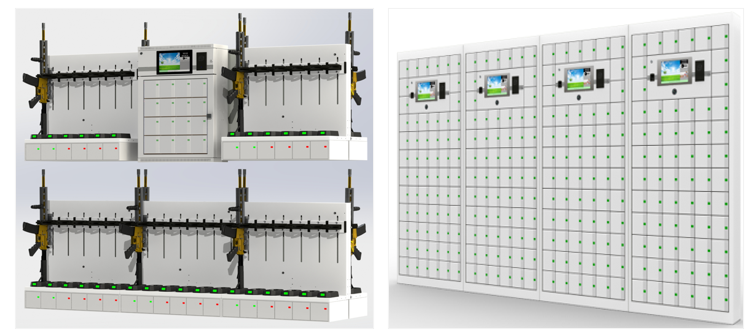
- Secure connection to floors and/or walls, with security features including anti-tilt, impact or torch use to attempt to breach the cabinets for entry or removal.
- Weapon racks provide locking clamps and butt enclosures to secure access to long guns and to protect weapons from unauthorized removal.
- Handgun lockers secure access to handguns and handgun magazines.
- Personnel are authenticated by PIN #, ID card scan and/or biometrics to control access to officers authorized for specific weapons, ammo and gear.
- LED lights turn green and locks un-lock for weapons and ammo the officer is authorized to remove.
- Butt enclosures include RFID sensors to automatically track weapon removals and returns.
- Butt enclosures include weighing scale to ensure that magazine has been removed from the weapon prior to return to storage.
- Magazine lockers include weighing scales to ensure that there are no missing rounds/bullets from magazines when magazines are placed into storage.
- Hand gun lockers include RFID to auto-track handguns that are removed or returned.
- Hand gun lockers include weighing scale to ensure that magazine was removed prior to returning the hand gun to storage.
- Handgun lockers include slots for magazines, with weighing scales to ensure that there are no missing bullets from magazines when placed into storage lockers.
Armory Management and Weapon Tracking System Deployment
Leading armory management weapon tracking system vendors install turn-key systems that include software, software configuration hardware, professional services, tags and labels, IT staff training and System User staff training.
The best choice for an armory management weapon tracking system is from a vendor that has a fully developed system that includes all of the features required for the management of weapons, gear and ammo, and that has been successfully deployed and proven across prior installations for police, military and security organizations.
It is always best to implement an armory management weapon tracking software solution that is configured to an organizations exacting data, tracking, workflow, security and reporting requirements. The armory management tracking system should be designed to perform in the manner and according to the processes that an organization is already using, with improvements and changes made to current processes for available improvements to operational performance.
To configure software requires a close collaborative working relationship between the organization implementing the system and the vendor that is assisting the organization with the system’s implementation. There are important features and data sets that are required to optimize armory management weapons tracking, including:
- Software templates like, weapons, gear, ammo and personnel.
- Customized data fields for each template that defines each item-type.
- Drop-down lists for appropriate data fields based on recurring data values, such as weapon-type or weapon-status lists.
- Define the Locations at which items can be located, such as warehouses, armories and the personnel authorized to receive weapons, gear and ammo.
- Define weapon statuses, such as active, inactive, damaged, surplused, etc.
- Define the tasks that are performed by the armory or weapons warehouse, such as personnel ID card renewals, personnel weapon certifications, weapon test firing, weapon cleaning, weapon inspection and similar tasks.
- If any tasks require multiple steps and/or actions or approvals from multiple personnel, the workflows are defined.
- Establish alert dates for each Task or Workflow that to define when a task is due for completion, to alert designated system Users responsible for task fulfilment, and to display on the armory management weapon tracking system’s software dashboard calendar.
Ongoing support and system maintenance
Top armory management weapon tracking system vendors provide ongoing system support and maintenance, to ensure that staff are continually trained and that all system components are operating to expected performance metrics. Typical ongoing armory management weapon tracking system support and maintenance includes:
- Periodic updates to the server and database software platforms, so that systems remain most-current based on the changing standards of leading software platforms like Microsoft, Oracle and many others.
- Peridodic update of the armory management weapon tracking system application software, to ensure that each organization utilizing the system has the most current version and can leverage the continued improvements to the COTS software over time.
- As needed training of system Users to ensure successful usage of the armory management weapon tracking system software and operation, and training support for new Users assigned to the system’s usage.
- Repair or replace hardware to ensure that all hardware is in place and performing to expected standards.
There are multiple methodologies for top armory management weapon tracking systems to be supported over time, wherever the organization is located globally, including:
- The vendor and developer of the armory management weapon tracking system must provide full and guaranteed support of all aspects of the system, including 365 x 7 x 24 customer service, emails, conference calls, web-meetings and onsite visits as required.
- The best armory management weapon tracking system vendors procure hardware from global, industry-leading manufacturers that provide onsite and remote hardware support, such as Zebra for barcode and RFID hardware (www.zebra.com) to ensure that their hardware is working properly, repaired or replaced.
- Top armory management weapon tracking system vendors often work with local partners in regions of countries, countries, regions of the globe or globally. As such, an organization implementing a leading armory management weapon tracking system receive local support for both installations and ongoing support through a local, trusted vendor.
Why is armory management weapon tracking important?
Appropriate considerations for an organization to analyse include 1) can we produce an accurate and complete inventory ‘right now’ showing the locations of all weapons, gear and ammo 2) if there is an event, such as a weapon being drawn and/or fired, will the systems in use and the documentation in place ensure that the organization has operated in a compliant manner to avoid legal issues or public perception challenges and 3) can we reconcile all weapons, gear and ammo inventory data and usage against original procurement data to ensure accountability of all weapons, gear and ammo.
Authorities in command of weapons, gear and ammo should have and know that their systems are state-of-the-art and provide them with the best opportunity to fully understand and monitor system-wide weapon, gear and ammo assets, as well as personnel and all facets of monitoring personnel and their readiness and certification to perform their duties.
However, most police, military and security organizations globally are managing armories and weapons warehouse much in the same way as they did at the time of WWII. Manual processes including clipboards, forms and documents in file folders. Such systems and processes are intrinsically slow, error-prone and inadequately ensure or defend compliance and operating procedures. Many military, police and security organizations have established sometimes complex spreadsheet systems for managing data about weapons, gear, ammo and personnel, but, spreadsheets are not a database, and spreadsheets are fundamentally limited in their level of performance, accuracy, capabilities and the ability to produce the reports and data that is needed at all and any point in time (https://blog.hubspot.com/sales/database-vs-spreadsheet).
The reasons that an armory management weapon tracking database technology solution is important include:
- Leverage the benefits of database management technology to have the best control of your data and operations.
- As may be appropriate, the armory management weapon tracking system can be synchronized and integrated with an organizations other database and software systems, such as Financial and ERP systems, for seamless information management.
- Ensure that the weapons, gear and ammo that were procured were received and accounted-for through documented receipt by armories, warehouses and depots.
- Speed the performance, accuracy and compliance of Issuing weapons, gear and ammo through the use of a database, entering item identification numbers, scanning barcodes or scanning RFID tags.
- Authenticate personnel by armory management weapon tracking system software look-up, CAC or identification card scanning, PIN number entry or fingerprint.
- Ensure that weapons being Issued to personnel match personnel assigned weapons, that personnel weapon certifications are current and that the person is marked OK TO ARM versus DO NOT ARM.
- Identify the duty or post to which personnel are being assigned, and auto-display the weapons, gear and ammo required for the post or duty assignment.
- Speed the performance, accuracy and compliance of weapons, gear and ammo being Returned to armories or weapon warehouses through automated software functions that auto-display the items that were Issued for ultra-fast and accurate tracking of weapons, gear and ammo being returned to armories and weapons warehouses.
- Achieve best practices accountability by capturing identification number input, fingerprint scan or electronic signature of the personnel receiving weapons, gear and ammo for validation of transfer-of-custody.
- Enable passive tracking of RFID-tagged weapons, gear and ammo without staff having to manually enter identification numbers or scan barcode labels or RFID tags, simply by passing items through an Issue-Return window.
- Armory and weapons warehouse standard operating procedures typically require a complete armory inventory after weapon, gear and ammo Issue and Return turnovers / shift changes. Mobile scanners enable rapid inventories of items with visible identification numbers, barcode labels and RFID tags. The mobile scanner can also be utilized to rapidly audit armories as to expected and located items. Typical armory inventories and audits are with clipboard and sheets of paper, or, laptop with spreadsheets, in both cases slow and error-prone. Mobile RFID – Barcode scanners typically reduce the time required for armory and weapon warehouse inventories by 90%+.
- Manual armory and warehouse management systems have inadequacies in providing weapons security and specifically the ability to identify weapons that approach an exit prior to the weapon(s) exiting the armory or weapons warehouse to visually and audibly alert armorers and staff in proximity that weapons are being removed from an armory or warehouse in an unauthorized manner.
Enhanced decision-making
Top armory management weapon tracking systems improve the speed, accuracy, compliance and security of armory, weapons warehouse and ammo depot operations. Real-time strategic data for commanders, authorities and Users that displays on software informational dashboards and that can be instantly queried and/or reports generated enables better knowledge, and hence enables better decision making.
Accountability of current and historical data related to weapons, gear, ammo and personnel
Armory, weapon warehouse and ammo depot accountability is optimized by having accurate, real-time data. Current and historical data is up-to-date and immediately available to system Users. Personnel authentication, transfer-of-custody, weapon certifications compliance, ARM/Do Not Arm and post requirements are all tracked and monitored real-time when weapons, gear and ammo are being Issued.
Improved ability to meet compliance requirements
Have accurate and up-to-date data. Leverage armory management weapons tracking system software and technology to embed business rules with system configuration, ensuring best operational compliance and also the production of any forms or reports that are required to demonstrate and document compliance.
Security and risk of loss or theft
Fundamentally, the most important security benefits that are gained through the use of armory management weapon tracking systems is to utilize software and technology to authenticate personnel and to validate transfer-of-custody, as described herein. That is the foundation of the management and security of weapons, gear and ammo.
Software, barcode and RFID technology ensures that weapons, gear and ammo that are being Issued-from or Returned-to an armory, weapons warehouse or ammo depot are correctly identified, entered or scanned and that the armory management weapon tracking system software is updated with current locations and provides location and accountability of data.
RFID security / tracking doorways include RFID antennas, alarms, lights and camera to prevent or to document all removals of weapons, gear and ammo, and specifically to prevent the unauthorized removal of weapons from armories or warehouses, or ammo from ammo depots.
Many armories are manned full time and there is no risk of the movements or weapons, gear or ammo going undocumented. However, other armories may not have full time staff overseeing operations and a self-service, secure armory system is required or desired. Top armory management weapon tracking system solution vendors offer smart weapon and magazine storage systems that operate in manned or autonomous mode, including self-service biometrics, RFID and weighing scales. These systems are particularly important for countries where there is risk of armory, weapon warehouse or ammo depot breach by ‘bad actors’. Smart Weapon Storage systems include important tracking and security benefits, including:
- Prevent unauthorized personnel from entering armories, weapon warehouses or ammo depots, and, prevent unauthorized personnel from receiving weapons, gear or ammo.
- Establish rigorous transfer-of-custody, chain-of-custody procedures to ensure accountability of all weapons at all times, to isolate custody in case a weapon ‘goes missing’.
- Utilize physical counts or weighing scales to ensure that magazines are removed from weapons and that there are no missing rounds, with automatic updates of ammo accountability and counts to the armory management weapon tracking system software.
- Prevent weapons from exiting armories in an unauthorized manner utilizing RFID, alarms, flashing lights and surveillance camera.
- Mount weapon storage cabinets to floors and/or walls and equip the weapon storage cabinets with locking doors and locks to make it difficult for ‘bad actors’ to access weapons if they breach an armory.
- Utilize heavy duty smart weapon and magazine storage systems that mount to floor and/or walls, and that include durable locks on sidearm and magazine lockers, and, longarm barrel clamps and butt holders, to prevent removal of weapons or magazines from armories, warehouse or depots by ‘bad actors’.
Organizations that Utilize Armory Management & Weapon Tracking Systems
Any organization that has a security detail with lethal weapons, gear and ammo, and similarly any organization that maintains non-lethal weapons should utilize a modern armory management weapon tracking system for tracking, accountability and security of the weapons, gear and ammo owned by the organization. It’s not just police, miliary or national security organizations that use armory management weapon tracking systems, there are many types of organizations, including:
- Military
- Police
- National Guard
- Security forces
- Sheriff departments
- Local government Corrections departments
- Federal government prisons
- Government ministries and agencies
- Courthouses
- Nuclear and other energy companies
- Mining companies
- Airports
- Universities
- Oil & Gas companies
- Building and property security companies
- Armored car companies
How to Prepare a Budget Request and Procure a Weapon Tracking System?
If there are obvious deficiencies in the procurement, accountability, tracking and/or security of weapons, gear and ammo, such as missing weapons and ‘black market’ selling of weapons, then there is an obvious need for a modern armory management weapon tracking system.
Periodically audit and review armory, weapon warehouse and ammo depot standard operating procedures, use of computerization and use of technology to determine if the management, accountability, tracking and security of weapons, gear and ammo can be enhanced through a leading armory management weapon tracking system.
Once the need or desire for modern armory management weapons tracking, research the marketplace to determine vendors to discuss your requirements and to assist you with establishing solution specifications for the armory management weapon tracking system that will best meet the needs identified by the organization internally, and through gaining insights from vendors and their experience with prior organizations and armory management weapon tracking system deployments. There are many methods for proceeding towards establishing specifications and a budget:
- Establish and internal team of stakeholders to undertake the task of performing internal analysis and external solution / vendor reviews, for the purpose of capturing the information that is required to establish and take recommendations to authority figures that can approve budget for implementing a top armory management weapon tracking system solution.
- An organization that seeks information about armory management weapon tracking solutions should query other military, police and security organizations in their country, or other countries, to determine if there have been successful armory management weapon tracking systems implemented by these trusted organizations. And, the organization should perform Google, Youtube or use similar Internet Search tools to identify leading armory management weapon tracking system vendors.
- Review the websites and the documents, videos and blogs that are included in armory management weapon tracking vendor websites. Carefully review each vendor’s capabilities and the references and prior projects which are indicated on vendor websites. Select one (1) to three (3) vendors to enter into discussions for the purpose of better understanding the types of armory management weapon tracking systems that are available, and to enhance your knowledge of what options and capabilities are available through armory management weapon tracking system vendors that best address your organization’s requirements.
- Contact your preferred vendors and request their standard presentations, brochures, white papers and videos for your team’s review and for provision to authority figures within your organization. Establish the reasoning that is the basis for considering the implementation of a leading armory management weapon tracking system. Indicate the types of solutions that have been identified with the capabilities to transform the organization’s armory management weapon tracking systems, technology and operations. Request armory management weapon tracking system presentations and software demonstrations from the preferred vendors that your team has identified. Present your case to decision-makers.
Establish a preliminary scope-of-work that you can provide to prospective vendors for the purpose of receiving a preliminary proposal/quotation. Some of the information that vendors will want to receive includes:
- How many armories? Warehouses? Depots?
- For each armory, warehouse and depot, produce an .xls that has a tab for each such Location. For the rows of these .xls sheets, list all of the item-types for each Location, the quantity for each item-type, and, indicate if the item-type is going to be labelled with barcod or tagged with RFID. For example:
| # | Armory 1 | ||
| Item-Types | Quantity | Barcode or RFID? | |
| Hand gun | |||
| Hand gun Magazine | |||
| Hand gun Weapon Attachment | |||
| Long Gun | |||
| Long Gun Weapon Attachment | |||
| Longarm Magazine | |||
| Sidearm Sight | |||
| Longarm Sight | |||
| Taser | |||
| Baton | |||
| OC Spray | |||
| Stinger Grenade | |||
| Leg Irons | |||
| Waist Chains | |||
| Door Ram | |||
| Holligan Tool | |||
| Ballistic Shield | |||
| Boxes of Ammo | |||
| Gun Safes | |||
| Radios | |||
| Vests | |||
| Night Vision Binoculars | |||
| Cases | |||
| Drones | |||
| Narcan | |||
| LiDAR | |||
| Personnel | |||
| Etc. |
- Will armaments, heavy weaponry, vehicles, watercraft and/or aircraft be identified and tracked by the armory management weapon tracking system? If so, identify each item-type and the quantity of each item-type.
- For each armory, warehouse or depot, describe the room or building layout, as to computer workstations utilized for tracking, Issue-Return windows, exits and the technologies of interest, such as:
| # | Infrastructure-type | Yes/No | Qty | Comments |
| ARMORY, WAREHOUSE OR DEPOT TITLE (Location) | ||||
| How many computer workstations at armory? | ||||
| How many room or facility exit-points? | ||||
| Is it your intention to track at Issue-Return windows? And/or at workstations within the room or facility? Are you interested in being able to mount hardware onto rolling carts that can be rolled to tracking stations and then rolled away after Issues-Returns are completed? How many tracking stations in total of how many of each type? Workstations within armoryPermanently mounted tracking station at Issue-Return windows Permanently mounted tracking station at doorwayTracking station on rolling cart | ||||
| How will personnel be authenticated? Are you interested in fingerprint personnel authentication? | ||||
| Will you validate chain-of-custody, and if so, will that be via electronic signature, fingerprint or identification PIN number? | ||||
| Is there interest in installing RFID, alarm, lights and/or camera at armory exit points? If so, how many? | ||||
| Do you want to track at outdoor personnel / vehicle checkpoints? If so, how many? |
Amory management weapon tracking system vendors will need to know IT requirements, including:
- Do you prefer a cloud or local, on-premises server deployment?
- If local server, will you provide the server(s) for the project or is vendor to provide server(s).
- Is a WiFi closed, private, secure network allowed?
- If a closed, private network is not allowed, and networking of tracking stations to server is required, will you provide the networking or is vendor required to install any required network / cabling?
- Each RFID fixed reader, if any are installed, such as at Issue-Return or doorway station(s), or where rolling carts will be positioned, will you provide Ethernet drops?
- Will integration with backend ERP, procurement or other database / software systems be required, and if so, please describe.
Once you have received preliminary proposals/quotations, evaluate armory management weapon tracking vendor offers. If a vendor and solution stands out as your preferred solution based on the solution offered, capabilities, proposal and pricing, request that the armory management weapon tracking system vendor provide you with a ‘Sole Source Justification’ document. Prepare your procurement request package for decision-makers and for the procurement department, and proceed accordingly.
As may be appropriate, request that vendor(s) arrange a site visit so that you can see for yourself a working weapon tracking system solution in operation, and/or request that the vendor come to your premises for a formal system demonstration and discussion.
Summary
This document is intended to prove a comprehensive view of armory management weapon tracking systems and the process to evaluate and procure an armory management weapon tracking system. Following are the key points from this document:
- Introduction and the need for modern armory management weapon tracking systems.
- Extensive overview explaining ‘what is an armory management weapon tracking system’ and what are its components.
- Explanation of the various tracking technologies that can be utilized for an armory management weapon tracking system.
- Description of the primary tracking capabilities and devices that are utilized with an armory management weapon tracking system.
- Description of the primary security capabilities and devices that are utilized with an armory management weapon tracking system.
- Discussed the requirements and provision of implementation and training services, and, ongoing support.
- Reviewed the importance of armory management weapon tracking systems.
- Discussed the kinds of organizations that should consider armory management weapon tracking systems for their operations.
- Outlined how to evaluate armory management tracking system vendors, approach the procurement process and select the vendor that you believe will provide you with the best system and support.
- Reviewed the kinds of information and data that a vendor will require to provide a preliminary proposal and quotation, including software, tracking and security hardware requirements and IT requirements.
You are encouraged to thoroughly evaluate the vendors and solutions that are available from global companies providing armory management weapon tracking solutions. The top leading best armory management system vendors will rise to the top, and those are the solutions and vendors that you should further evaluate.
The Future of Armory Management Weapon Tracking Systems
The requirements of military, police and security organizations for armory, warehouse and depot management are well defined, and these requirements will only nominally change over time.
The primary attribute of armory management weapon tracking systems is the implementation of database management software that replaces manual processes, paperwork and spreadsheets. Top armory management weapon tracking system vendors have already worked with worldwide leading military, police and security organizations and have developed their software to address the needs of the global weapons management marketplace. As such, the armory management weapon tracking system software will not substantively change in the future, and the onset of artificial intelligence and other emerging technology trends are not expected to have much or any impact as to the design and operation of armory management weapon tracking systems.
However, technology, hardware and tags are rapidly advancing. Tracking and security technology will continually advance, but, this will take time. It should be expected notwithstanding that a major breakthrough with existing or new technologies occurs, which is not expected, that the technologies and hardware available today should remain best-practices for years to come, approximately five (5) years or much further into the future. But, the specific hardware and tags used with current tracking and security technologies will incrementally improve on a year-to-year basis, and should be expected to improve performance and/or reduce pricing over time.
In a manner, it is up to someone like you, that deals with weapons and armories on a day-to-day basis in the real-world, with actual operational environments, that decide the future of armory management weapon tracking systems. In our view, the importance of armory, weapon/gear/ammo warehouses and ammo depots is self-evident, and the priority to ensure that these operations are most efficient, meet standard-operating-procedures, meet compliance requirements, ensure accountability and foster confidence from civil society…the public. Given the political nature of the world today, including political and geo-political conflicts, every organization, particularly national military and police entities, should ensure that their systems, technologies and processes enable the highest degree of accountability and security. In this author’s view, this discussion should be at the highest level of command, and if current systems are sub-optimal, those systems should be improved.
GSM-GPS real-time tracking is rapidly advancing, as is currently the most significant advancement related to weapon tracking. Knowing where weapons are located, and receiving tactical alerts, such as unholstering, shot(s), fired, weapon separated from officer, geo-fence breach, tag tamper and panic button pressed provide real-time data to enhance officer and public safety.
About us
We are Tracker IoT LLC (www.trackeriot.com), specializing in armory management weapon tracking systems (www.weapontrackingiot.com).
Our team’s experience with armory management weapon tracking systems initiated in 2007 with implementation of a double-blind procurement/warehouse management system to identify and track all weapons, gear and ammo procured by the U.S. Department of State, stored in the warehouse, maintained by armory staff, and Issued to embassies and agents worldwide. What we learned with and from the U.S. Department of State set the foundation for our understanding of armory management weapon tracking system requirements, knowledge gained by the U.S. Department of States leading weapons, gear and ammo procurement and armory experts.
After installing the U.S. Department of State’s armory/warehouse management weapon tracking system in 2007, in 2009 our team worked with a large contingent of U.S. Air Force armory and weapons management experts to determine how to best modify the solution designed for the U.S. Department of State to meet the requirements and standard-operating-procedures of the U.S. Air Force for base security armories and firing ranges. Specifically, the U.S. Air Force sought to establish a centralized software database of all weapons, gear and ammo stored in armories, improve the speed and accuracy of Issues and Returns, lock-down tracking and accountability, and quicken the time required for performing armory inventories and audits.
Our team has installed multiple armory management weapon tracking systems for the U.S. Air Force, U.S. Air National Guard, U.S. Army, U.S. Space Force and similar clients domestically and globally.
Over subsequent years, our team has worked with U.S. Police, Sheriff Offices and Corrections departments to optimize how these organizations manage weapons, gear and ammo. And we have worked with international clients like the Royal Bermuda Regiment, Bermuda Police Services, Saudia Arabia Royal Guard, Al-Udeid Air Base, Camp Arifjan and other clients globally.
Our armory management weapon tracking website www.weapontrackingiot.com provides an overview of our capabilities.
Our solutions platform and our team also fully support additional capabilities, so that a single solution can assist our clients with fulfilling needs or a wide range of applications, including:
- Heavy weaponry
- Vehicles
- Personnel
- Vehicle assets
- Facility assets
- Industrial assets
- Documents/folios, files and archives
- Seized property and evidence
- Tools
- Parts
- Warehouse tracking
Our business creed is based on doing what is in our customers best interests, and providing the best, optimized solutions that we can create through collaboration with our customers. The collaborative process between a customer and vendor enables an organization to make decisions in the manner that the organization deems is in their best interests. The best indicator of future success is prior success.
Please contact us if we can assist you in any way. We welcome every opportunity to be of service.
info@trackeriot.com
+941 375 9437 (mobile / Whatsapp)
www.weapontrackingiot.com

About Author
Eric Collins has been designing and delivering tracking systems since the 1980’s, and led the development of one of the industry’s first digital, computerized armory management systems in 2007. The initial iteration of the armory management system was developed for the U.S. Department of State for tracking all weapons, gear and ammo issued to embassies and agents worldwide, and the solution has continually evolved based on the requirements of military and law enforcement organizations globally. The armory management system includes rapidly configurable software that is configured for each customers exacting requirements, including integration with barcode, RFID (radio wave) and security devices. Most recently, Eric co-developed one of the industry’s first GPS-GSM real-time weapon tags, including alerts if geo-fence breach, weapon unholstered, weapon separated from officer or shots fired.